

Introduction
When I first started working on large-scale Azure migrations, I believed success was mostly about moving servers and applications to the cloud as quickly as possible. Very soon, reality proved otherwise. Without a strong foundation, cloud environments become difficult to manage, insecure, and expensive.
That is when I truly understood the value of Microsoft’s Cloud Adoption Framework (CAF) and Azure Landing Zones; not as documentation, but as a practical operating model that works in real-world enterprise environments.
In this blog, I share my hands-on experience of how I applied CAF, built Azure Landing Zones, and what I learned at each stage.
What is CAF?
The Azure Cloud Adoption Framework (CAF) is a structured, end-to-end guidance framework created by Microsoft to help organizations plan, adopt, and manage Azure successfully. It provides best practices, tools, and methodologies to ensure cloud adoption is secure, scalable, and aligned with business goals.
CAF is not just about technology—it covers people, process, governance, and operations.
Core Phases of CAF
- Strategy - Defines why the organization is moving to the cloud.
- Plan - Defines what and when to move.
- Ready - Prepares Azure for workloads.
- Adopt - Moves and modernizes workloads.
- Govern - Ensures control and compliance.
- Secure - Enhance Security aligning to Zero Trust
- Manage - Handles daily operations.
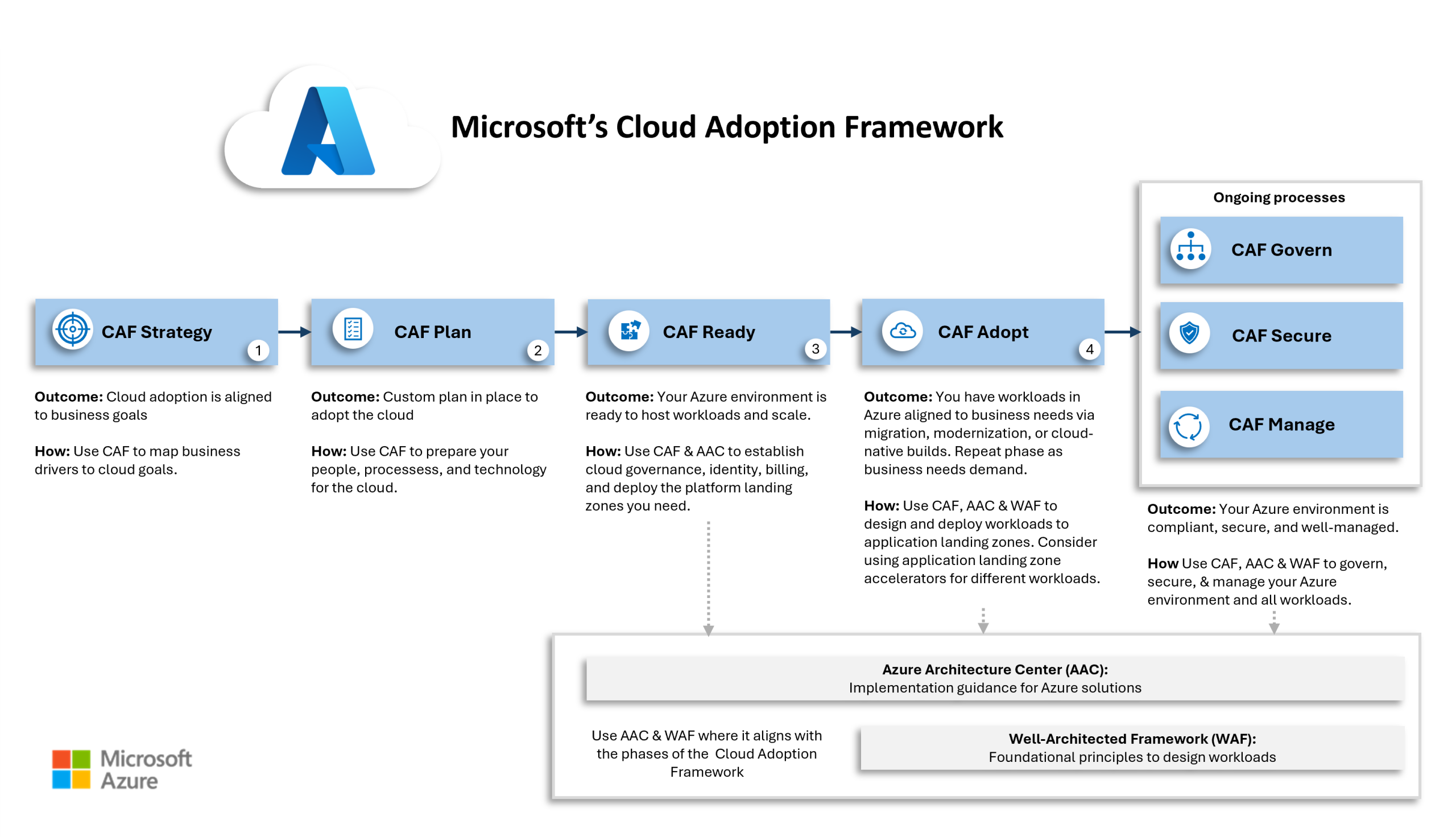
Azure CAF is Microsoft’s best-practice framework that guides organizations to plan, build, migrate, govern, and manage Azure environments successfully.
1. Strategy - Aligning Cloud with Business Reality
My first major lesson was this: cloud adoption is not a technical project, it’s a business transformation.
Before touching Azure, I worked closely with business stakeholders to understand:

Experience:
In one project, the business wanted “cloud migration” but what they really needed was high availability and disaster recovery. In another, the goal was to move from CapEx-heavy infrastructure to a predictable OpEx model.
CAF’s Strategy phase helped me frame these conversations properly. Instead of asking “What servers do you have?”, I started asking “What outcomes do you expect from Azure?”
This changed everything from architecture decisions to budget planning.
2. Plan - Turning Ambition into a Practical Roadmap
Once strategy was clear, the next challenge was planning.
In real projects, environments are never clean. Applications are interconnected, documentation is outdated, and dependencies are often tribal knowledge. I used the Plan phase of CAF to:
This is where I learned the importance of subscription strategy. Instead of putting everything into one subscription, I designed:
This planning reduced future conflicts and made governance much easier.
Guys, the above is one of the planning task/activity, there are so many things to consider from networking to access including the user connectivity

Figure: Technical Planning, refer below link
https://learn.microsoft.com/en-us/azure/cloud-adoption-framework/plan/prepare-organization-for-cloud
3. Ready
This phase was the most impactful in my experience.
Rather than migrating workloads immediately, I focused on building a proper Azure Landing Zone. At first, some teams questioned this approach as “Why are we delaying migration?” but later, everyone appreciated the decision.
this is a mechanism of setting up the foundational setup a structured approach that helps you build a scalable, secure, and governed cloud environment from the start.

Figure : Azure Landing Zone design areas; refer the below link
https://learn.microsoft.com/en-us/azure/cloud-adoption-framework/ready/
One of the key examples are
1. Management Groups & Governance
I structured management groups to reflect the organization:
Azure Policies were applied centrally, enforcing:
This ensured consistency without micromanaging teams.
2. Identity & Access:
Reach me over lets discuss about this 😉
3. Networking:
Reach me over lets discuss about this 😉

Figure : Azure Landing Zone design areas; refer the below link
https://learn.microsoft.com/en-us/azure/cloud-adoption-framework/ready/landing-zone/design-areas

Figure: Azure landing zone reference architecture. refer the below link
https://learn.microsoft.com/en-us/azure/cloud-adoption-framework/ready/landing-zone/
For each areas, there are different landing zones; data landing zone, security landing zone, etc.
4. Adopt
Once the landing zone was ready, migration felt… surprisingly smooth.
The adoptation involves, either we execute a migration or a modernization
Using Azure Migrate, I applied different strategies:

Figure: This is a very high-level strategies of moving towards Cloud
https://learn.microsoft.com/en-us/azure/cloud-adoption-framework/migrate/plan-migration
Because security, networking, and governance were already in place, teams could focus purely on application readiness. There were fewer surprises and far less rework.
6. Govern
Initially, governance was seen as a blocker. Over time, it became a safety net.
Cloud governance is how an organization controls its use of cloud services by establishing guardrails. These guardrails are set of policies, procedures, and tools that define acceptable and unacceptable cloud activities. Effective cloud governance aligns cloud usage with business objectives, mitigates risks, ensures regulatory compliance, and prevents unmanaged or unauthorized cloud actions. In practice, cloud governance covers key domains such as security, regulatory compliance, operations, cost management, data management, resource provisioning, and even emerging areas like AI.
Cloud governance is not a one-time project, but a continuous process. After initial setup, it requires ongoing monitoring, evaluation, and updates to adapt to new technologies, evolving risks, and changing requirements.

By applying governance at the landing zone level:
Instead of reacting to issues, we prevented them.
7. Manage
The true test of any cloud environment is not go-live, it’s day-2-day operations.
Managing an Azure environment goes far beyond basic operational continuity. It requires maintaining strong governance and security while continuously aligning cloud operations with evolving business objectives. As environments scale, it becomes critical to prevent configuration drift, standardize deployments through infrastructure as code, and manage change in a controlled and effective manner.

The Cloud Adoption Framework (CAF) – Manage methodology addresses these needs through the RAMP approach (Ready, Administer, Monitor, Protect). RAMP offers a structured model for organizing operational teams, defining clear responsibilities, and implementing the right processes and tools to ensure secure, compliant, and resilient Azure operations. By covering everything from daily administration to proactive monitoring and protection against disruptions, RAMP establishes a robust operational foundation that supports long-term cloud success.
With CAF’s Manage phase, I focused on:
Because the foundation was solid, operations were predictable, scalable, and auditable.
Who Should Use CAF? (highly recommended)
- Enterprises migrating from on-premises
- Government and regulated industries
- Organizations scaling Azure usage
- Cloud architects and IT leaders
- Believe me, everyone thinking of CLOUD, should align to this
Conclusion:
The reason why I Trust CAF and Azure Landing Zones
After multiple projects across different industries, I can confidently say this:
My experience taught me that the best cloud environments are the ones users barely notice as they just work, securely and efficiently.
Cloud adoption is not about lifting servers; it’s about building a future-ready platform.
Note: Each phase of the Cloud Adoption Framework includes additional depth beyond what is covered here. This overview addresses only the high-level concepts; more detailed exploration will be provided in upcoming sessions and topics. refer this link to get more indepth knowledge on CAF
https://learn.microsoft.com/en-us/azure/cloud-adoption-framework/overview
